
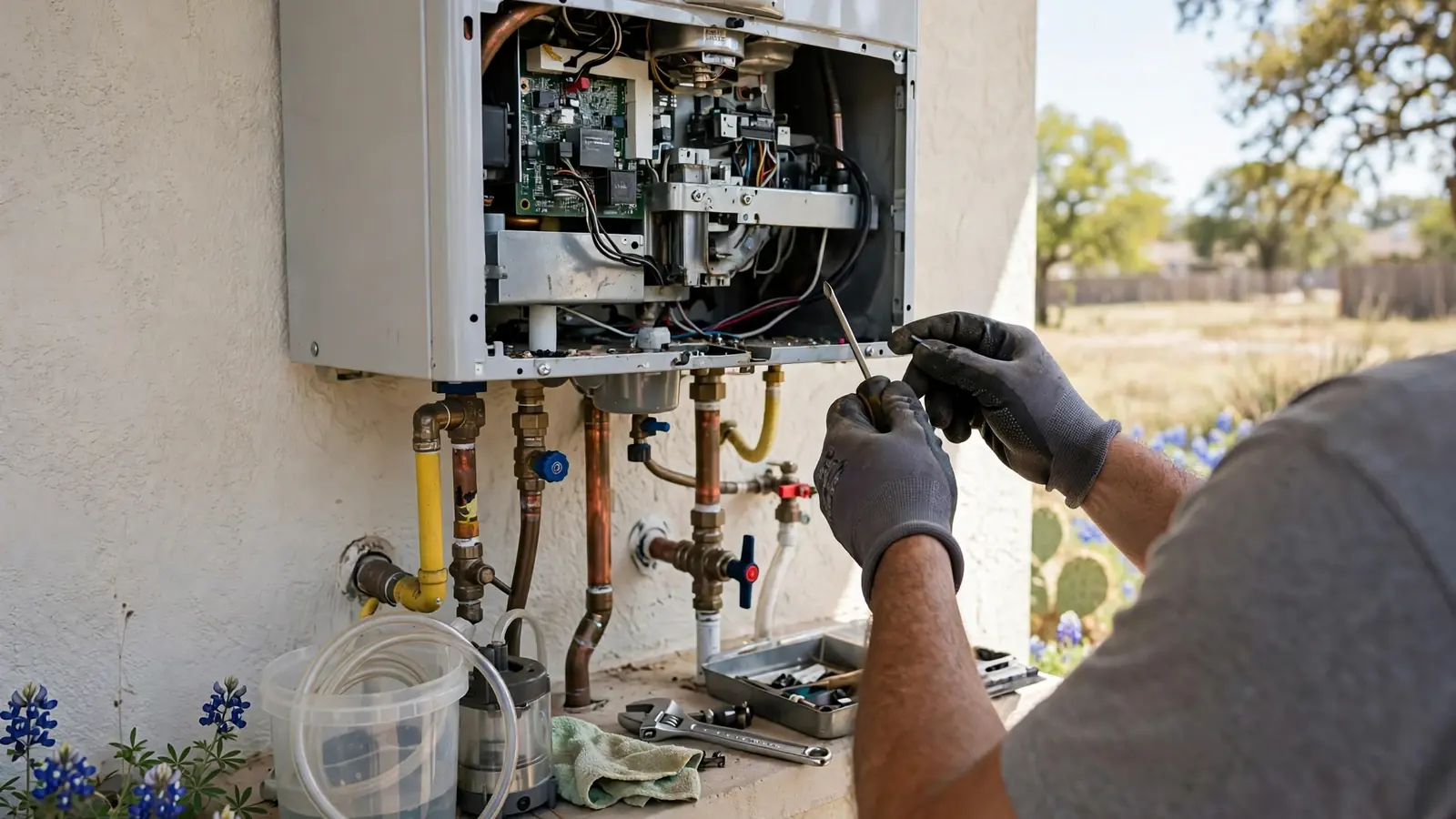
Where a tankless water heater can leak.
| Location. | Likely cause. | Seriousness. |
|---|---|---|
| Water connections at the bottom. | Loose fittings or worn washers. | Often a simple repair. |
| Pressure relief valve. | High pressure or a worn valve. | Needs attention soon. |
| Isolation valves. | Worn seals. | Fix before it worsens. |
| Heat exchanger. | Corrosion or scale damage. | May need a new unit. |
| Condensate drain. | Normal water from a condensing unit. | Not a leak if it drains correctly. |
| Vent connection. | Condensation running back. | Needs a vent check. |
A high efficiency condensing tankless unit makes water on purpose. Cooled exhaust forms condensate, which drains through a small pipe. A wet floor under the drain line can be normal, and a wet floor under the water connections is not.
How to tell a leak from condensation.
- Look at the water's path. Condensate comes from the drain line or the vent, not from the water pipes.
- Dry the area and check again an hour later with the unit running.
- Tape a dry paper towel under each connection to see which one is wet.
- Check whether the pressure relief valve is dripping.
- Note whether the leak grows when hot water runs.
Mineral buildup can also cause leaks. Scale inside the unit makes parts work harder and can damage seals. A yearly flush is part of owning a tankless unit, and our tankless water heater page explains what the service covers.
What to do when you find water.
- Shut off the cold water supply to the unit with its isolation valve.
- Turn off the power or gas to the unit, using its switch or the gas valve nearby.
- Put a towel or a shallow pan below the leak and note where the water is coming from.
- Take a photo for your records and for the plumber.
- Call a plumber. Do not run the unit with a known leak.
A small drip at a fitting is cheap to fix. A leak from the heat exchanger usually means replacing the unit, and water heater repair explains the diagnosis. If the unit is beyond repair, replacement is the next step.
Why tankless leaks happen.
A tankless unit heats water quickly, and that heat stresses seals and joints over many cycles. Mineral scale in hard water coats the heat exchanger and makes it run hotter. Over time, scale and heat cause small cracks or weeping joints.
Freezing is another cause. A unit mounted in an unheated space, or a vent that lets in cold air, can freeze water in the exchanger. Frozen water expands and cracks the metal, and the leak shows after it thaws.
Scale.
Mineral buildup raises temperature and wears seals.
Freeze damage.
A cold space or draft can split the exchanger.
Loose or worn fittings.
Vibration and heat cycles loosen connections.
High water pressure.
Pressure above what the unit allows stresses the relief valve.
Keeping a tankless unit from leaking.
- Have the unit flushed on a yearly schedule, more often if the water is hard.
- Clean the inlet filter screen when you flush.
- Keep the space around the unit above freezing.
- Check the connections and the relief valve for drips when you flush.
- Keep the pressure within the range the maker gives.
A short yearly visit costs less than a heat exchanger. Our tankless water heater service covers the flush and the checks above.
Repair or replace a leaking tankless heater.
| Leak source. | Usual answer. | Reason. |
|---|---|---|
| Loose fitting or washer. | Repair. | Low-cost parts and quick work. |
| Isolation valve. | Replace the valve. | Seals wear out. |
| Relief valve. | Diagnose pressure, then replace the valve if needed. | The valve may be reacting to high pressure. |
| Heat exchanger crack. | Often replace the unit. | The part is a large part of the unit. |
What not to do with a leaking unit.
- Do not tighten a fitting hard while the unit is hot or powered.
- Do not cover a dripping relief valve with a cap or plug it. It is a safety device.
- Do not wrap a leaking heat exchanger in tape and keep using the unit.
- Do not ignore a small weep. Water near gas or power parts grows into a bigger problem.
A relief valve that drips is telling you something. It may be reacting to pressure, to heat or to a worn seat. A plumber can test which, and the answer decides whether a new valve or a pressure fix is needed.
Keep a record of the date and the place you first saw water. It helps the plumber and any warranty claim.
What to tell the plumber when you call.
Say where the water is, whether the unit is gas or electric, and how old it is. Mention if you have seen scale on the faucet screens or if the unit shows an error code. Tell the dispatcher if the leak grows when hot water runs.
Photos help. A clear picture of the label with the model number lets the plumber bring the right seals and valves on the first visit.
Bayonne note: the January 2026 boil water advisory and your unit.
Bayonne issued a boil water advisory from January 22 to January 24, 2026, after a 30-inch main was damaged in South Kearny. When it lifted, the city recommended running faucets for three to five minutes and said water heaters set below 113 degrees Fahrenheit should be drained and refilled, and that softeners and filters should be regenerated.
A tankless unit has no tank to drain, but a flush of the unit and its filter screen is a reasonable follow-up if you see sediment or a new drip. We also service units in Jersey City and Hoboken.
Source type: City of Bayonne notice lifting the January 2026 boil water advisory.
Questions Bayonne homeowners ask about tankless leaks.
It may be a loose connection, a worn valve or normal condensation from a condensing unit. Trace the water to find which.
Water near gas or power connections is a risk. Shut off the supply and call a plumber.
It is better not to. A small leak can grow, and water may reach electrical parts.
It can damage seals and the heat exchanger over time. A yearly flush helps.
The city advised flushing taps and draining tank heaters. For a tankless unit, a flush and a filter check are reasonable if you notice sediment.