
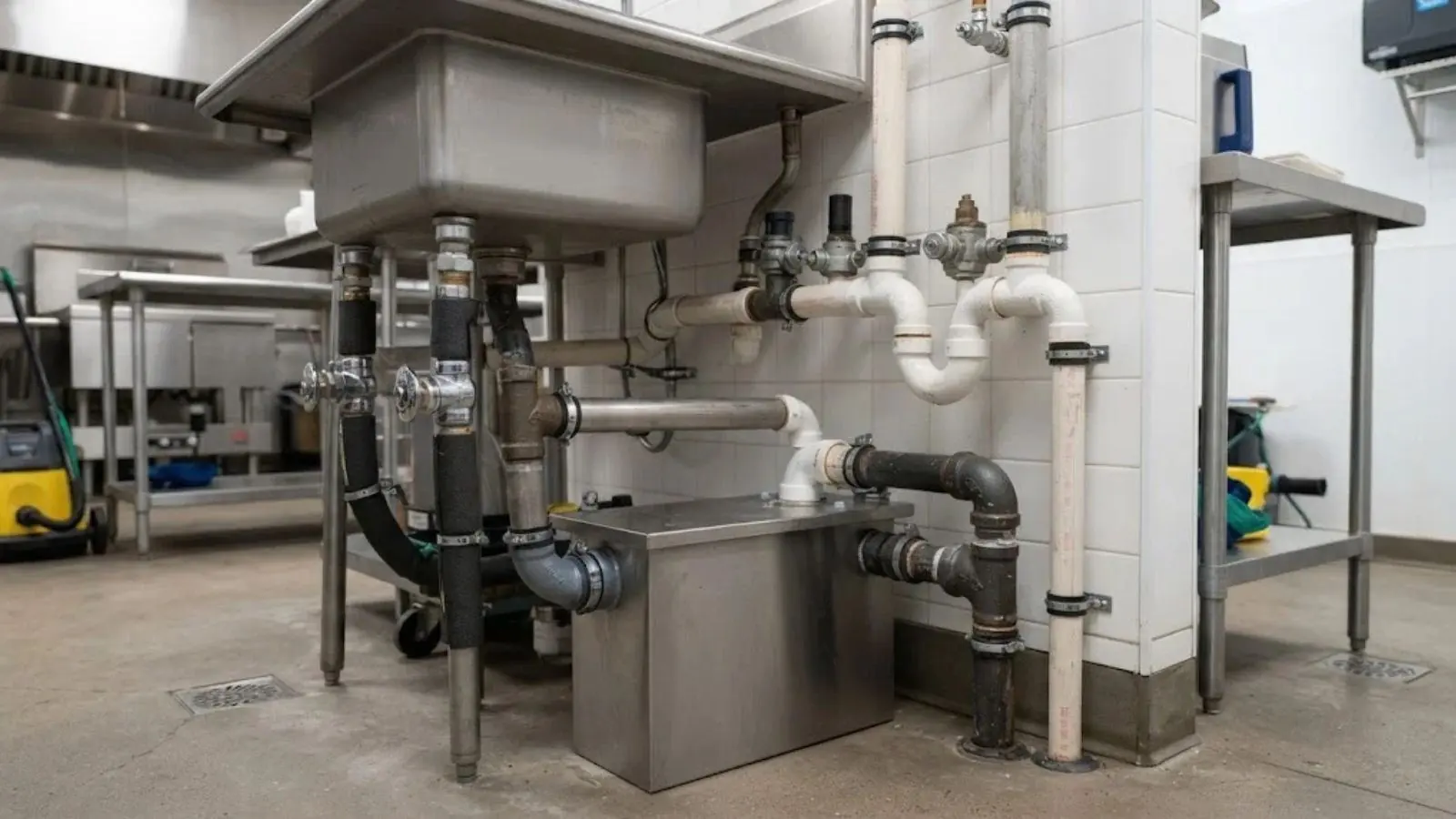
Commercial plumbing emergency: what we handle after hours.
Commercial plumbing covers the pipes, drains, heaters and fixtures in shops, restaurants, offices and multi-unit buildings. The systems are larger than a house, the lines run farther and a failure often affects more than one tenant.
Typical emergency calls are a backed-up floor drain or grease line, a burst supply pipe, a failed water heater, a toilet or urinal overflow, and a leak in a ceiling or wall that reaches the unit below. Close the nearest isolation valve and call. Delay raises the damage and the downtime.
Kitchen and grease lines.
Fat and food waste build up in drains and traps, then back up into the kitchen.
Restroom failures.
Overflowing toilets, running urinals and clogged floor drains can close a restroom.
Water heater failure.
A commercial heater that fails stops dishwashing, cleaning and hand washing.
Ceiling and wall leaks.
A leak in a shared riser can affect neighboring units.
Commercial work follows the same state plumbing subcode, a published standard, and the master plumber rule, with permits and inspections for new installs. The subcode also sets cross-connection and backflow rules that point to New Jersey Department of Environmental Protection requirements.
Shops and offices in Jersey City can reach the same after-hours line.
Shops and small businesses share Constable Hook with homes, and our page on a plumber in Constable Hook covers how those calls differ.
Backflow testing, grease traps and planned maintenance.
Backflow prevention devices protect the public water supply from contamination when pressure changes. Many commercial properties have them on the water service, irrigation or fire lines, and they must be tested on schedule. Ask your local water utility and the building department which tests apply to your building.
Grease traps and interceptors need regular cleaning so fat does not reach the sewer. A scheduled service costs less than an emergency backup on a busy night. For stubborn lines, hydro jetting clears a full pipe.
| Need. | Why it matters. | How often to plan. |
|---|---|---|
| Grease trap cleaning. | Prevents kitchen backups and sewer blockages. | Set by volume and local rules. |
| Backflow test. | Protects the water supply and meets requirements. | Per local rules, usually yearly. |
| Drain jetting. | Keeps busy lines clear. | Based on how fast they build up. |
| Water heater service. | Avoids sudden loss of hot water. | Yearly check. |
Leak detection in commercial buildings: what to expect.
Commercial leak detection is harder than in a house, because pipes run longer, are shared and are hidden above ceilings and behind finished walls. Detection tools help, but the plumber may need records of the building's plumbing and access to several units. It is not always possible to find a leak in one visit.
If you are a tenant, tell the building owner or manager as soon as you see a leak. Responsibility for pipes in walls, risers and shared lines often sits with the owner, while the tenant is responsible for fixtures in the unit. Check your lease. See leak detection for the methods used.
Commercial plumbing in Bayonne: Broadway, Kennedy Boulevard and the industrial blocks.
Broadway in Midtown Bayonne is the main commercial street, and Kennedy Boulevard is a major county road through the city. Businesses on those streets share building drains and water services with neighbors and tenants. Constable Hook includes industrial areas where lines may be larger and see heavier use.
Veolia operates the water mains and sewer lines in Bayonne and the city keeps ownership. Your private service line and the plumbing inside the building are yours to maintain. For a backup that affects the street, call Veolia as well.
The building department at 630 Avenue C handles permits. Its page covers emergency work after hours and a 72-hour window for contractors to come in for permits after emergency work, so ask what applies before a large repair. For a restaurant, ask the health office about grease and sanitation rules too.
What affects the price of commercial plumbing.
Insurance note.
Business insurance varies widely. Property and business interruption cover sudden water damage in many policies, but not always sewer backup or gradual leaks. Check with your agent and photograph the damage and the downtime.
Want your real number? Call (718) 412-8453. We give a clear price before work starts.
What to do before the plumber reaches your shop.
- Stop service in the affected area and keep customers and staff away from wet floors..
- Close the main water valve if a supply line is leaking. Know where it is before you need it..
- Switch off power to wet equipment only if you can reach the switch dry..
- Photograph the damage and note the time, for your landlord and insurer..
- Tell the dispatcher about grease traps, floor drains and shared building lines..
Business plumbing emergency?
Call the 24/7 line. We book the next available plumber.
Commercial plumbing questions in Bayonne.
Yes. The line is open 24/7, including holidays. Call (718) 412-8453, say what kind of business you run and what failed, and the dispatcher books the next available plumber.
Grease trap cleaning is one of the planned services we can book. Ask the dispatcher about your trap size and schedule.
Requirements come from the water utility and the building or health authorities. Ask Veolia and the Bayonne building department what applies, and have a certified tester do the test.
Tell both the building owner and the manager right away. Pipes in walls and shared risers are usually the owner's responsibility, but check your lease.
Yes. Regular jetting and trap cleaning keep lines clear. A plumber can suggest a schedule after seeing how fast the line builds up.