
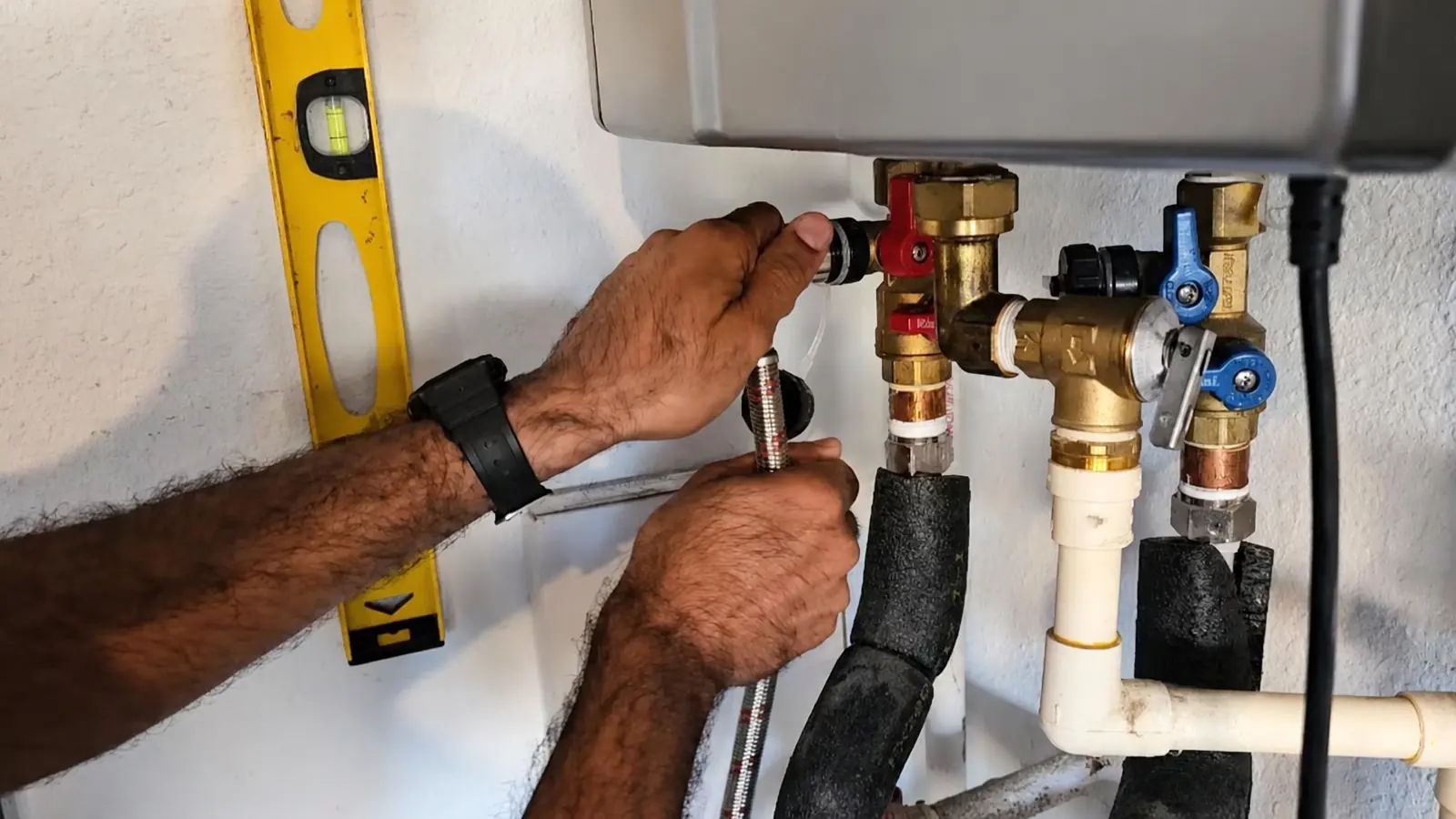
Why tankless heaters are sized in gallons per minute.
A tank stores hot water, so its size in gallons tells you how much is on hand. A tankless unit heats water as it passes through, so its limit is how many gallons per minute it can raise to the temperature you want. That depends on the incoming water temperature and the burner or element power.
A 40 gallon tank heats a full tank and recovers slowly. A tankless unit never runs out as long as demand stays within its flow rating. If three showers run at once, the unit may only supply two at a good temperature, and that is the limit to plan around.
| Question. | 40 gallon tank. | Tankless unit. |
|---|---|---|
| What limits you. | Gallons stored. | Flow in gallons per minute. |
| Running out of hot water. | Possible after heavy use. | Not while demand stays within flow. |
| Standby heat loss. | Yes, the tank stays hot. | No stored hot water. |
| Space. | Needs floor space. | Wall mounted and compact. |
| Gas and vent needs. | Standard gas line and flue. | Larger gas line and sealed vent common. |
How to size a tankless unit for your household.
Count the fixtures that run at the same time during your busiest morning, then add their flow rates. A shower, a kitchen faucet and a dishwasher together may need a few gallons per minute. The plumber checks the incoming water temperature, because cold winter water needs more heating than warm summer water.
- List the hot water fixtures you use at the same time.
- Add the flow rate of each, which is printed on the fixture or in its manual.
- Note your coldest incoming water temperature in winter.
- Ask the plumber to match a unit that supports that flow at that temperature rise.
- Check gas line size and vent path before you buy the unit.
Do not size from the tank alone. A household of two with efficient fixtures may be well served by a small unit, while a large family with two bathrooms may need a bigger one or two units.
Gas line, vent and descaling: the hidden costs.
Most gas tankless units draw a lot of gas for a short burst. An existing gas line sized for a tank may be too small. The vent is often a sealed pipe through the wall or roof, which is different from a tank flue.
Maintenance is part of the plan. Mineral scale builds inside the heat exchanger, and a yearly flush and descale keeps it working. See our tankless water heater page for what a service visit covers, and water heater installation if you decide to stay with a tank.
Gas or electric tankless: what changes.
Electric tankless units avoid the gas line and the vent, but they pull a large electric load. A house with a small panel may need an upgrade. Gas units need less electric power but more gas flow and a sealed vent.
| Fuel. | Main requirement. | Common hurdle. |
|---|---|---|
| Gas. | Enough gas line capacity and a sealed vent. | An older line sized for a tank. |
| Electric. | A large dedicated circuit. | A panel without spare capacity. |
Ask the plumber to check both before you pick a unit. The fuel you already have usually costs less to keep.
When a tank is still the better answer.
Tankless is not always the right move. A rental apartment, a house with very small hot water demand or a building where a new vent cannot be run may be better served by a tank. The cost of gas line and vent changes can outweigh the savings.
- A tank suits a low-demand home where venting would be costly..
- A tankless unit suits a household with long, heavy hot water use and space for the vent..
- Two units can split the load in a large home..
- Ask for both options priced side by side..
A quick sizing worksheet.
Write down every hot water fixture in the house and its flow in gallons per minute. A typical shower head, a kitchen tap and a dishwasher are the usual morning trio. Add only the ones that run at the same time.
Then look at the unit's rating at the temperature rise you need. Winter water is colder, so the same unit delivers fewer gallons per minute in January than in July. Size for January, because that is when a shortfall shows.
If the total is close to the limit, ask about a larger unit or two units. A small step up costs far less than living with lukewarm showers.
Bayonne note: gas supply work on Avenue C and water quality.
PSE&G is replacing aging cast iron gas pipe in Bayonne with plastic or coated steel piping, and its project page lists Avenue C from 21st through 53rd Street. If your street is on the list, ask the plumber to confirm the service line and meter before you commit to a tankless unit, because gas capacity is the first thing a tankless install depends on.
Ask Veolia for its annual water quality report to see hardness for the Bayonne system, which tells you how often to descale. We also size tankless units for homes in Jersey City and Hoboken, where the water comes from a different system.
Source type: PSE&G Bayonne gas construction page and Veolia's Bayonne water system information.
Questions Bayonne homeowners ask about tankless heaters.
No. Tankless units have no tank, so they are rated by flow. The plumber matches a unit to the fixtures you run at the same time.
Not as long as demand stays within its flow rating. If too many fixtures run at once, the temperature drops, so sizing matters.
Often yes. The plumber checks the line size, the meter and the vent path before recommending a unit.
It depends on water hardness and use. A yearly check is a reasonable start.
It can, because gas capacity matters. PSE&G lists work along Avenue C from 21st through 53rd Street. Ask your plumber to confirm the service line before ordering a unit.