
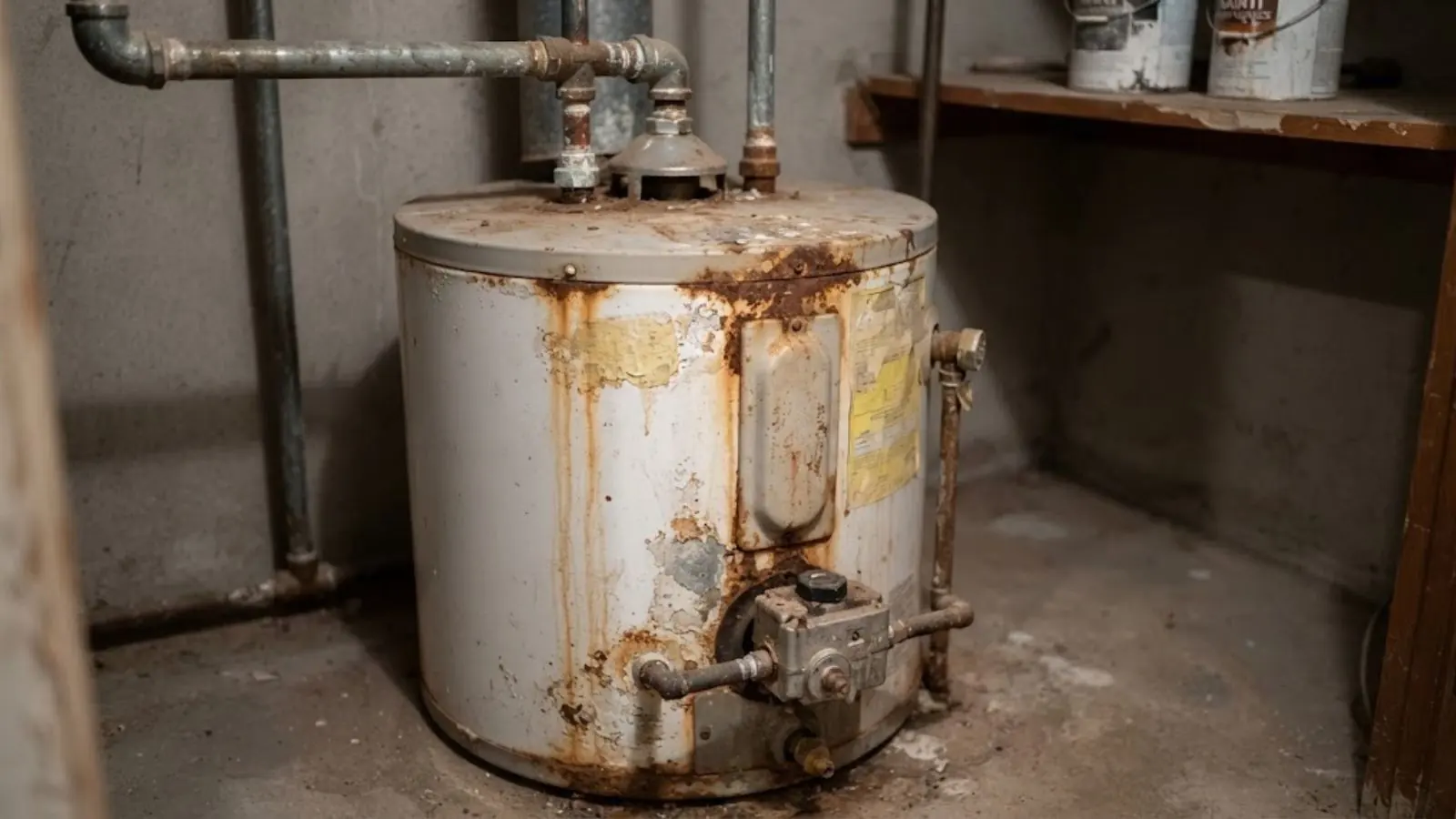
What the vent pipe does.
A gas water heater has a burner at the bottom of the tank and a flue running through its center. Hot exhaust rises through the flue into a vent connector, then through a vent pipe to the outdoors. The warm exhaust rises on its own in an atmospheric vent, so the pipe must rise steadily and stay sealed at the joints.
Other designs push exhaust out with a fan through a sealed pipe in the wall. Those power vent and direct vent units use different pipe material and different rules. The correct type depends on the heater, not on what is convenient.
| Vent type. | How exhaust leaves. | What to know. |
|---|---|---|
| Atmospheric vent. | Warm exhaust rises through a pipe or chimney. | Needs enough rise and a clear path. |
| Power vent. | A fan pushes exhaust through a pipe. | Needs power and a drain for condensate in some cases. |
| Direct vent. | Sealed intake and exhaust pipes through a wall. | Needs the right termination point. |
Signs of a vent problem.
Soot or scorch marks.
Black marks around the top of the heater or the draft hood suggest exhaust spilling out.
Rust or stains on the vent pipe.
Moisture and corrosion can mean the vent is not drawing well.
A burner that flickers or goes out.
Poor draft can disturb the flame.
A carbon monoxide alarm sounds.
Treat any alarm as real. Leave the building and call 911.
Carbon monoxide and gas.
If a carbon monoxide alarm sounds, leave the building and call 911 from outside. If you smell gas, leave, move at least 350 feet away and call PSE&G at 1-800-880-7734 or 911. Do not use switches or phones inside.
Do not rely on smell for carbon monoxide, because it has none. Working alarms on every level and near sleeping areas are the basic protection.
Why vent work belongs to a licensed plumber.
Vent sizing depends on the heater input, the length and the number of elbows. The slope, the clearance from combustibles and the termination point all have rules. A pipe that looks fine can still draw badly, and a mistake may not show until a cold day or a second appliance runs.
A plumber who installs or replaces a heater checks the existing vent, replaces damaged parts and tests for spillage after startup. Read our water heater replacement page to see how a swap is done, and water heater installation for a first-time install.
- Ask whether the vent is being reused or replaced.
- Ask how the plumber tests for exhaust spillage after startup.
- Ask whether the work needs a permit and who files it.
- Replace a damaged or rusted vent pipe, rather than patching it.
Questions to ask before the install.
| Question. | Why it matters. |
|---|---|
| Is the vent type correct for this heater? | A power vent needs different parts than an atmospheric vent. |
| Is the old vent in good shape? | Corrosion and loose joints can leak exhaust. |
| Will you test for spillage? | Testing proves the exhaust leaves the building. |
| Is a permit needed? | It affects inspection and insurance. |
What a plumber checks during a vent inspection.
- The vent pipe for rust, gaps, loose joints and sagging.
- The rise and run of the vent, where the building allows.
- The termination point outside, for blockage and clearance.
- Signs of backdrafting, such as soot or scorch marks near the draft hood.
- Burner flame shape and color once the heater is running.
A short test with a draft check or a combustion analyzer shows whether exhaust leaves the building as it should. The result matters more than how the pipe looks.
Other appliances share the air.
A gas heater draws air from the room. A tight house, a strong kitchen exhaust fan or a dryer running together can pull air the wrong way. That is why a vent that worked for years can start spilling after a renovation or a new appliance.
If you have changed windows, added insulation or fitted a new range hood, tell the plumber. It can change how the vent behaves, and it may call for a fresh air supply.
Carbon monoxide alarms: the basic protection.
A working carbon monoxide alarm is the simplest protection against a venting fault. Place one on every level and near sleeping areas. Test it monthly and replace it by the date on its label.
An alarm does not replace a vent inspection. It warns you when exhaust has already entered the home. A yearly check of the water heater and its vent finds problems before the alarm does.
Bayonne note: PSE&G gas leak steps and the building department.
PSE&G says that if you smell gas you should leave right away, get 350 feet away and call 1-800-880-PSEG or 911 from outside. Its Bayonne project page also lists cast iron gas pipe replacement along Avenue C from 21st through 53rd Street. If your heater acts up after street gas work, say so when you call a plumber.
The Bayonne building department is at 630 Avenue C, and a heater replacement may need a permit depending on the work. Ask before you start. We also work in Jersey City and Hoboken.
Source type: PSE&G gas leak guidance and Bayonne project page, and City of Bayonne building department page.
Questions Bayonne homeowners ask about heater vents.
It is not a good idea. Vent sizing, slope and clearances matter for safety, and a licensed plumber tests for spillage afterward.
A plumber tests it with the heater running. Soot, rust stains or a flickering burner are signs to call.
Leave the building and call 911 from outside. Do not go back in to find the cause.
Often it is checked and reused if sound. A damaged or wrong-size vent is replaced.
Leave the building and call PSE&G at 1-800-880-7734 or 911 from outside. Call a plumber after the utility says it is safe.